Choosing the Right Laser Power: From 40W Hobbyist to 3000W Industrial
Selecting the correct laser power is a critical decision that determines the speed, quality, and material thickness your machine can handle. Whether you’re a weekend hobbyist or a high-volume industrial manufacturer, choosing the right wattage is essential for optimizing your workflow and ROI.
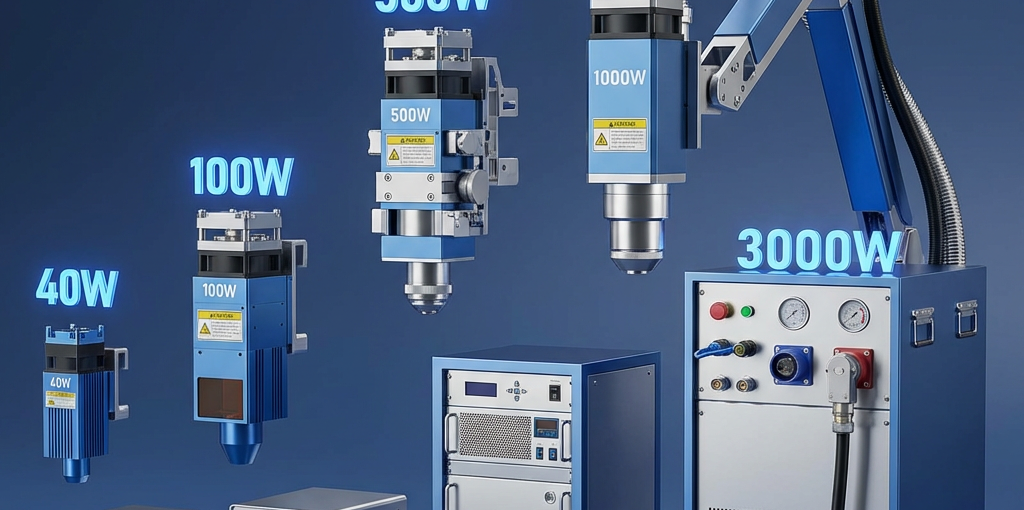
40W to 100W: The Hobbyist and Entry-Level Range
This power range is ideal for small shops, makerspaces, and individuals starting their laser journey.
- Materials: Wood, acrylic, paper, leather, and some plastics.
- Typical Uses: Custom engraving, small craft items, architectural models, and personalized gifts.
- Capabilities: Can cut thin plywood (up to 3-6mm) and acrylic (up to 6-8mm) with multiple passes or slow speeds. Engraving detail is often excellent in this range.
150W to 500W: The Mid-Range Workhorse
Stepping up to this range allows for faster production and the ability to cut through thicker non-metallic materials, or even thin metals (with specialized equipment).
- Materials: Thick wood (up to 20mm), thick acrylic, and thin stainless steel (using specialized 150W+ CO2 or fiber units).
- Typical Uses: Signage, industrial gaskets, automotive parts, and furniture components.
- Capabilities: Significantly faster cutting speeds than the 40-100W range. Better productivity for small-to-medium manufacturing batches.
1000W to 2000W: Industrial Entry-Level (Fiber Laser)
This is where fiber laser technology truly begins to dominate. This power level is designed for industrial metal fabrication.
- Materials: Stainless steel (up to 8mm), carbon steel (up to 12mm), aluminum (up to 4mm).
- Typical Uses: Sheet metal fabrication, kitchenware, and industrial machinery parts.
- Capabilities: High-speed precision cutting of metals. These machines are designed for 24/7 operation and high uptime.
3000W and Beyond: High-Capacity Industrial Production
At 3000W and above, you are looking at serious heavy-duty production. These machines are the backbone of large-scale manufacturing.
- Materials: Thick carbon steel (up to 20mm+), stainless steel (up to 12mm+), and thick non-ferrous metals like brass and copper.
- Typical Uses: Shipbuilding, aerospace, structural steel fabrication, and heavy equipment manufacturing.
- Capabilities: Unmatched cutting speeds on medium-to-thick metals. Exceptional piercing speeds and high-quality edge finishes on thick plates.
Summary Comparison Table
| Power Level | Category | Key Materials | Primary Application |
|---|---|---|---|
| 40W-100W | Hobbyist | Wood, Acrylic | Engraving, Crafts |
| 150W-500W | Mid-Range | Thick Wood, Signage | Small Production |
| 1000W-2000W | Industrial | Metals (up to 8-12mm) | Metal Fabrication |
| 3000W+ | High Industrial | Heavy Metals (20mm+) | Shipbuilding, Aerospace |
Conclusion
Choosing the right laser power is all about matching the tool to the task. Don’t overpay for power you don’t need, but also don’t bottleneck your production with an underpowered machine.
At CNC Parts Market, we offer a wide range of laser power sources and machines to fit every budget and application. Explore our catalog or talk to an advisor today.