Understanding Laser Safety Classes: Protecting Your Workshop
Laser machines are powerful tools that offer incredible precision and productivity. However, the same concentrated light energy that allows a laser to cut through thick steel or engrave intricate patterns also poses a significant risk to human health, specifically the eyes and skin.
Understanding Laser Safety Classes is the first step toward creating a safe working environment. In this guide, we’ll break down the different classes of lasers and the protective measures you must take in your workshop.
1. What are Laser Safety Classes?
Lasers are categorized into classes based on their potential to cause harm. These classes are defined by international standards (such as IEC 60825-1) and range from Class 1 (entirely safe) to Class 4 (highly dangerous).
- Class 1: These lasers are safe under all conditions of normal use. Many industrial laser cutters are Class 1 systems because the high-powered laser is completely enclosed within a light-tight housing.
- Class 2: These are low-power visible lasers (like laser pointers). The human eye’s natural blink reflex (aversion response) is usually enough to protect against injury.
- Class 3R and 3B: These are medium-power lasers. Class 3B lasers can cause immediate eye injury from a direct beam or a specular (mirror-like) reflection.
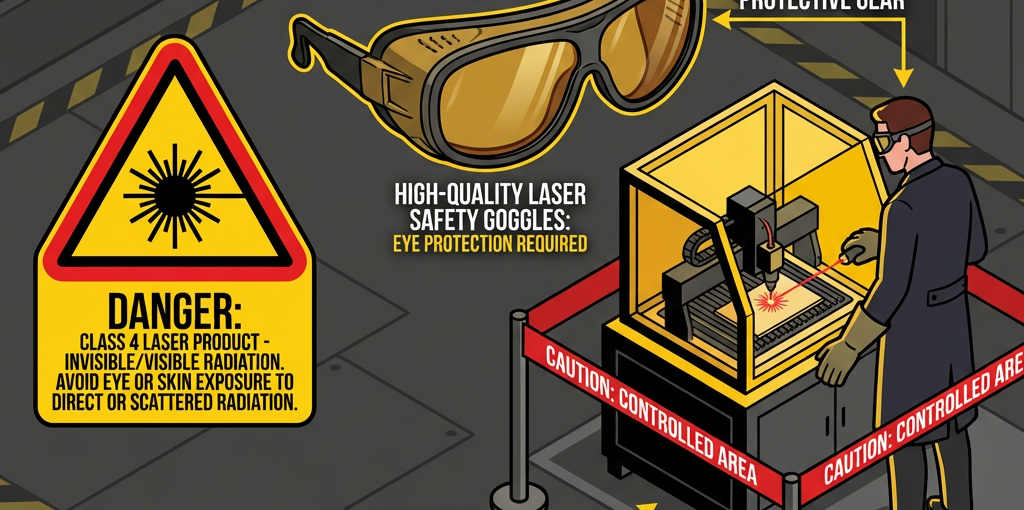
- Class 4: This class includes most industrial CO2 and fiber laser sources. These lasers are extremely dangerous. Even a diffuse reflection (light bouncing off a non-shiny surface) can cause permanent eye damage or severe skin burns. They also pose a significant fire hazard.
2. Essential Safety Equipment
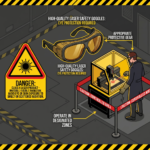
For any workshop operating Class 3B or Class 4 lasers, the following safety gear is mandatory:
- Laser Safety Goggles: These are the most critical piece of PPE. You must use goggles that are specifically rated for the wavelength of your laser (e.g., 10.6µm for CO2 or 1064nm for fiber). The “Optical Density” (OD) rating on the goggles tells you how much of the laser energy is blocked.
- Protective Housing and Interlocks: If your machine is not fully enclosed, you should build or buy a certified laser-safe housing. Safety interlocks ensure that the laser automatically shuts off if the door or access panel is opened.
- Fume Extraction: Laser cutting generates smoke, fumes, and fine particles that can be toxic. A high-quality exhaust and filtration system is essential for maintaining air quality.
3. Workshop Best Practices
- Warning Signs: Clearly mark your workshop or laser area with signs indicating the class of laser being used.
- Remove Reflective Objects: Ensure there are no mirrors, chrome-plated tools, or shiny jewelry in the path of the laser beam.
- Authorized Personnel Only: Only trained and authorized operators should have access to the laser machine’s controls and the restricted laser area.
- Never Leave a Laser Unattended: A fire can start in seconds if the material being cut catches light. Always remain at the machine during operation.
Conclusion
Laser safety is not something that should be taken lightly. By understanding the risks associated with Class 4 industrial lasers and implementing robust safety protocols, you can enjoy the benefits of this amazing technology while keeping yourself and your team safe.
Need replacement parts, safety sensors, or expert advice on laser maintenance? Explore our Laser Machine and Components Collection for all your industrial needs.