Laser Cutting vs. Mechanical Routing: When to Use Which Technology
In the modern manufacturing workshop, two tools stand head-and-shoulders above the rest: the CNC Laser and the CNC Router. Both machines can take a digital file and turn it into a physical part, but they work in fundamentally different ways.
If you’re wondering which machine is right for your project—or if you should add a second machine to your shop—this guide will compare the strengths and weaknesses of each.
How They Work
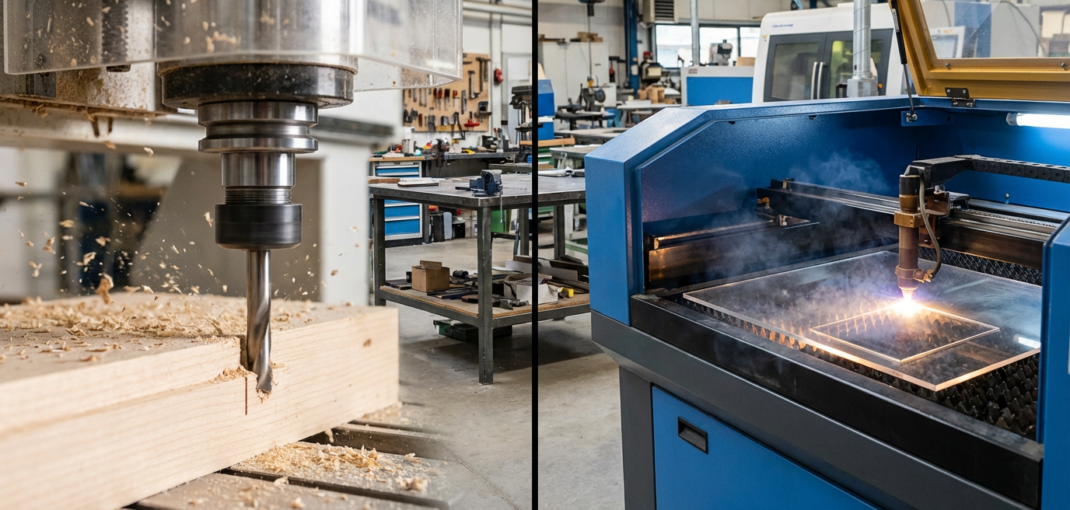
CNC Router: This is a mechanical cutting process. A spindle spins a sharp bit (end mill) at high speeds (up to 24,000 RPM) to physically carve away material. It’s like a high-precision, computer-controlled chisel.
CNC Laser: This is a thermal process. A high-power beam of light (CO2 or Fiber) is focused to a tiny point, where it melts, burns, or vaporizes the material. It’s like a high-precision, computer-controlled blowtorch.
Head-to-Head Comparison
| Feature | CNC Router | CNC Laser |
|---|---|---|
| Material Types | Wood, Plastics, Aluminum, Brass, Composites. | Wood, Plastics, Steel, Stainless Steel, Fabric, Leather. |
| Material Thickness | Up to several inches (limited by bit length). | Typically up to 3/4″ (limited by beam focus and power). |
| Edge Finish | Clean, but requires sanding or polishing. | Finished, often “flame-polished” on acrylic. |
| Detail Ability | Limited by the bit diameter (min. 1/32″ or 0.8mm). | Incredible detail (min. 0.005″ or 0.1mm). |
| Complexity | Excellent for 3D carving and pockets. | Primarily 2D cutting and 2.5D engraving. |
When to Choose a CNC Router
A CNC router is the “workhorse” of the shop. You should choose it when:
- You’re Cutting Thick Materials: If you need to cut 3/4″ (18mm) plywood or thick aluminum plates, a router is faster and more powerful.
- You Need 3D Shapes: A laser can’t carve a 3D topographic map or a curved cabinet door. Only a router can change its cutting depth (Z-axis) while moving.
- You Need Mechanical Joinery: For making cabinet parts, drawers, and furniture with tenon joints, a router’s ability to cut precise pockets is essential.
When to Choose a CNC Laser
A CNC laser is the “precision tool” of the shop. You should choose it when:
- You Need Intricate Details: If you’re engraving tiny text or cutting complex lace-like patterns in paper or wood, a laser is the only option.
- You Want a Finished Edge: When cutting acrylic, a CO2 laser will “flame-polish” the edge as it cuts, leaving it crystal clear and ready to use.
- You’re Cutting Fragile Materials: Since a laser doesn’t touch the material, it exerts no physical pressure. This makes it perfect for thin fabrics, leather, and films that a router would tear.
The “Hybrid” Workshop
Many professional makers choose to have both.
- The Router handles the heavy lifting—bulk material removal, 3D carving, and large structural parts.
- The Laser handles the fine details—logo engraving, small precision parts, and clean acrylic work.
Conclusion
Neither machine is “better” than the other—they are simply different tools for different jobs. If you’re focused on woodworking and furniture, a CNC router is your primary tool. If you’re focused on signage, awards, and intricate crafts, a laser will be your best investment.
Ready to upgrade your shop? Whether you need a high-speed spindle for your router or a replacement lens for your laser, find the best parts at cncpartsmarket.com!