CNC Vacuum Tables vs. Mechanical Clamping: Which Workholding Solution is Best?
Every CNC project starts with the same challenge: how to hold the workpiece securely. The quality of your cut, the speed of your production, and the safety of your operation all depend on your “workholding.”
In this article, we’ll compare the two most common workholding solutions: Vacuum Tables and Mechanical Clamping. We’ll help you decide which one is best for your CNC shop.
1. Mechanical Clamping: The Reliable Standard
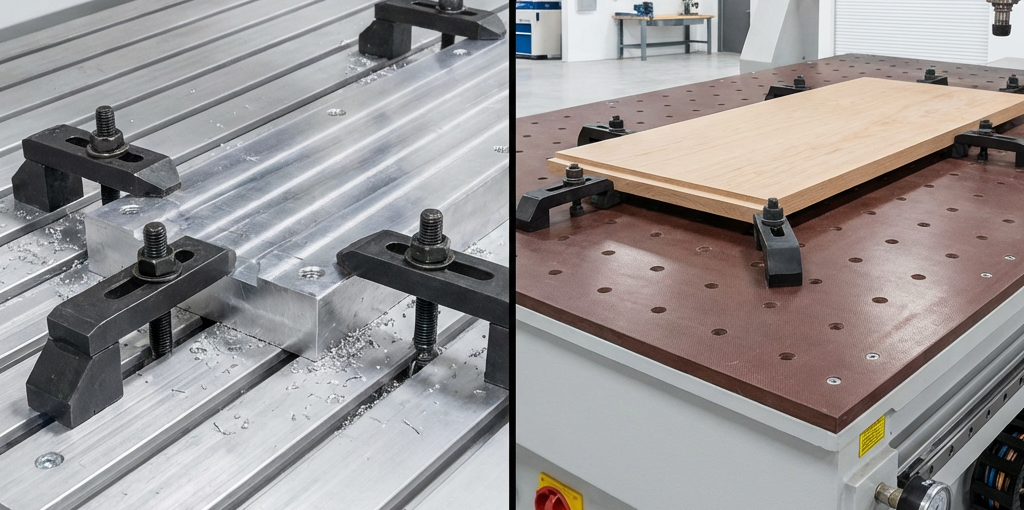
Mechanical clamping involves using T-track bolts, toe clamps, or toggle clamps to physically press the workpiece against the machine bed.
Advantages of Mechanical Clamping
- Universal Compatibility: You can hold almost anything, from odd-shaped blocks to thick metal plates.
- Low Cost: A set of clamps and a T-slot table is significantly cheaper than a vacuum system.
- Extreme Holding Power: For heavy-duty milling in aluminum or steel, mechanical clamps offer the highest “bite.”
Disadvantages of Mechanical Clamping
- Slow Setup: Each piece must be manually clamped, which adds up in production runs.
- Risk of Tool Collision: You must carefully program your toolpaths to avoid hitting the metal clamps.
- Edge Access: Clamps often block the edges of the workpiece, making it difficult to cut the full perimeter.
2. Vacuum Tables: The Production Speedster
A vacuum table uses a powerful vacuum pump to pull a workpiece down onto a sacrificial “spoilboard” (usually MDF).
Advantages of Vacuum Tables
- Incredible Speed: Place the material, flip a switch, and start cutting. Perfect for high-volume cabinet or sign making.
- Full Perimeter Access: Since the holding force is from below, you can cut the entire outer edge without hitting any clamps.
- No Manual Layout: You don’t need to plan “safe zones” for clamps in your CAD/CAM software.
Disadvantages of Vacuum Tables
- High Initial Cost: You’ll need a vacuum pump (regenerative blower or rotary vane), piping, and a custom table.
- Material Sensitivity: Vacuum works best on large, flat sheets. Small parts or porous materials (like some low-quality plywood) may not hold securely.
- Power Consumption: A 5HP to 10HP vacuum pump can significantly increase your electricity bill.
Which One Should You Choose?
Choose Mechanical Clamping If:
- You are a hobbyist on a budget.
- You mostly cut small, thick parts or metal.
- You work with irregular-shaped pieces.
Choose a Vacuum Table If:
- You are running a commercial business.
- You mostly cut 4×8 sheets of plywood, MDF, or acrylic.
- Production speed and turnaround time are your top priorities.
The Hybrid Solution
Many professional shops use a Hybrid Table—an aluminum T-slot table with vacuum zones. This gives you the best of both worlds: vacuum for sheet goods and mechanical clamping for everything else.
Conclusion
Both systems have their place in a modern CNC shop. Start with mechanical clamps for versatility, and as your production volume grows, consider investing in a high-performance vacuum system to take your business to the next level.
Looking for workholding accessories? Check out our CNC Clamping Kits and Vacuum Accessories at CNC Parts Market.