Choosing the Right Spindle Inverter (VFD): A Guide to Parameters and Wiring
In the world of CNC machining, the spindle is the heart of the operation, but the Variable Frequency Drive (VFD)—often called an inverter—is its brain. A VFD controls the speed, torque, and direction of your CNC spindle by varying the frequency and voltage of the power supplied to it. Selecting the right VFD and configuring it correctly is crucial for both machine performance and the longevity of your motor.
In this guide, we’ll walk you through the essential parameters to consider when choosing a VFD and provide a basic overview of wiring for a successful setup.
1. Key Parameters for Choosing a VFD
When selecting an inverter for your CNC spindle, several technical specifications must align with your motor’s requirements.
Power Rating (kW)
The VFD’s power rating should always match or exceed the spindle’s power rating. If you have a 2.2kW spindle, you need at least a 2.2kW VFD. Using a slightly higher-rated VFD (e.g., 3.0kW for a 2.2kW motor) is often recommended as it provides a safety margin and can handle load spikes more effectively.
Input and Output Voltage
Check your shop’s power supply and your spindle’s requirements. Most hobbyist and light-industrial spindles are either 110V or 220V (Single-phase or Three-phase). Ensure the VFD can take your input voltage (e.g., single-phase 220V) and output the necessary voltage for the spindle (usually three-phase 220V).
Frequency Range (Hz)
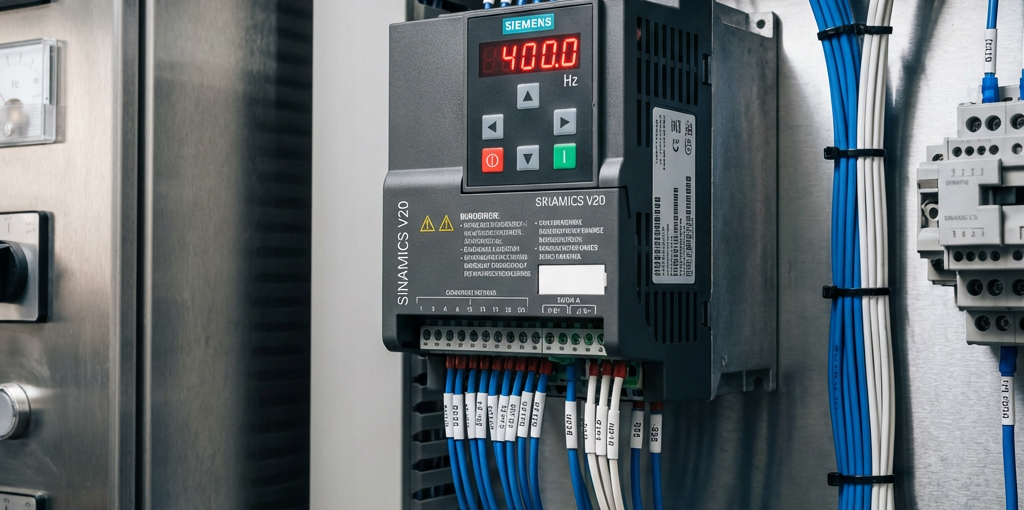
High-speed CNC spindles typically run at 400Hz (24,000 RPM). Your VFD must be capable of reaching this frequency. Standard industrial VFDs might be capped at 50Hz or 60Hz, which is insufficient for CNC applications. Look for “High-Frequency” VFDs.
Amperage (A)
The output current rating of the VFD must meet the spindle’s maximum current draw. Check the nameplate on your spindle for the “Full Load Amps” (FLA) rating.
2. Essential VFD Parameters to Program
Once you have your VFD, you must program it before running the spindle. Incorrect settings can lead to immediate motor failure (burning the windings).
| Parameter | Common Setting | Description |
|---|---|---|
| Base Frequency | 400Hz | The rated frequency of the motor. |
| Max Frequency | 400Hz | The maximum speed allowed. |
| Min Frequency | 100Hz | Prevents the motor from running too slow (overheating). |
| Rated Voltage | 220V | Matches the spindle nameplate. |
| Acceleration Time | 5-10s | Time taken to reach full speed. |
| Deceleration Time | 5-10s | Time taken to come to a stop. |
Note: Always consult your specific VFD manual, as parameter codes (like P001, PD005) vary between brands like Huanyang, Delta, or Fuling.
3. Basic Wiring Overview
Wiring a VFD involves two main sections: Power Input/Output and Control Signals.
Power Wiring
- Input (L, N, E): Connect your mains power to the input terminals. For 220V single-phase, use L and N. Always connect the Ground/Earth (E).
- Output (U, V, W): Connect these three terminals to the three pins on your spindle motor. If the motor spins in reverse, simply swap any two of these wires (e.g., swap U and V).
Control Wiring
To control the spindle via your CNC software (like Mach3 or LinuxCNC), you’ll use the low-voltage control terminals:
- FOR/REV: For direction control.
- VI/ACM: For 0-10V analog speed control from your breakout board.
- Multi-function Inputs: Can be used for “Emergency Stop” or “Reset” signals.
4. Best Practices for VFD Installation
- Use Shielded Cable: Between the VFD and the spindle, always use shielded 4-core cable to prevent Electromagnetic Interference (EMI) from affecting your sensors and controller.
- Ground Everything: Ensure the spindle body, the VFD, and the control cabinet are all properly grounded to a single point.
- Cooling: VFDs generate heat. Mount them in a ventilated enclosure, ideally with a dedicated cooling fan.
Conclusion
Choosing the right VFD is about matching the specs of your spindle while allowing for a bit of headroom. By paying close attention to the frequency and voltage settings during programming, you ensure a safe and efficient machining environment.
Are you looking for a reliable VFD for your next build? Check out our selection of high-performance spindle inverters at CNC Parts Market!