Choosing Between Fiber Laser and UV Laser for Precision Marking
When it comes to high-speed, high-precision industrial marking, two technologies stand out: fiber lasers and UV lasers. While both offer exceptional performance, they operate on different principles and are suited for different materials. Selecting the right one for your application is critical for achieving optimal results without damaging the substrate.
In this article, we compare the key differences between fiber and UV laser marking systems and provide a guide for making the right choice.
What is Fiber Laser Marking?
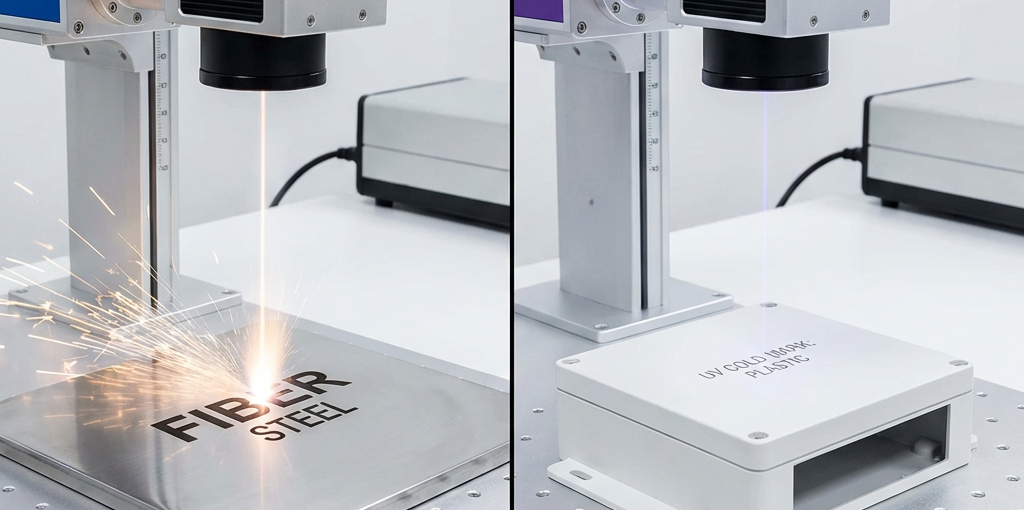
Fiber lasers typically operate at a wavelength of 1064nm, which is in the infrared spectrum. They use a “thermal” process where the laser beam heats the surface of the material, causing it to change color, oxidize, or vaporize.
- Primary Mechanism: Heat-induced marking (thermal marking).
- Best Materials: Metals (stainless steel, aluminum, brass, titanium), certain hard plastics, and ceramics.
- Key Advantages: Extremely high speed, long lifespan (up to 100,000 hours), low maintenance, and highly durable marks.
- Limitations: The heat generated can damage or warp thin materials, and it’s not suitable for many plastics, wood, or glass.
What is UV Laser Marking?
UV lasers operate at a much shorter wavelength, typically 355nm. Instead of heating the material, the high-energy UV photons break the molecular bonds of the material’s surface in a process known as “photo-ablation” or “cold marking.”
- Primary Mechanism: Chemical bond-breaking (non-thermal marking).
- Best Materials: Almost all plastics (including heat-sensitive ones like PVC and Teflon), glass, silicon, and even some fabrics or wood.
- Key Advantages: Ultra-fine precision, zero heat-affected zone (no burning or warping), and the ability to mark a wide variety of non-metallic materials.
- Limitations: Slower marking speed than fiber lasers and generally shorter lifespan for the laser source.
Fiber vs. UV Laser: A Side-by-Side Comparison
| Feature | Fiber Laser (1064nm) | UV Laser (355nm) |
|---|---|---|
| Marking Process | Thermal (Heat) | Cold (Chemical) |
| Speed | High | Moderate |
| Precision | High | Ultra-High |
| Heat Affected Zone | Present | None |
| Metal Marking | Excellent | Good (shallow) |
| Plastic Marking | Limited to hard/dark plastics | Excellent for all plastics |
| Glass Marking | Not Recommended | Excellent |
| Maintenance | Minimal | Moderate |
How to Choose the Right Laser for Your Project
Choose a Fiber Laser if:
- You primarily work with metals. Whether you’re marking serial numbers on automotive parts or decorative designs on stainless steel tumblers, a fiber laser is the industry standard.
- Speed is your top priority. In high-volume production lines where seconds count, the fiber laser’s speed is unmatched.
- You need deep engraving. If you need to remove material to a significant depth, the thermal energy of a fiber laser is required.
Choose a UV Laser if:
- You work with heat-sensitive plastics. For medical devices, electronics housings, or cables, a UV laser provides a crisp mark without melting the material.
- You need to mark on glass. UV lasers can mark on the surface of glass without creating the micro-fractures often caused by CO2 lasers.
- The highest precision is required. For marking tiny components or extremely detailed logos, the smaller spot size of the UV beam is superior.
Conclusion
The choice between a fiber laser and a UV laser boils down to the material you are marking and the sensitivity of that material to heat. Fiber lasers are the workhorses of the metal industry, offering speed and durability. UV lasers, on the other hand, are the specialists for “difficult” materials, providing ultra-clean, non-destructive marking.
Looking to invest in a fiber laser or UV laser marking system? Explore the options at CNC Parts Market to find the perfect fit for your business.