Understanding CNC Controller Boards: A Guide to Popular Systems
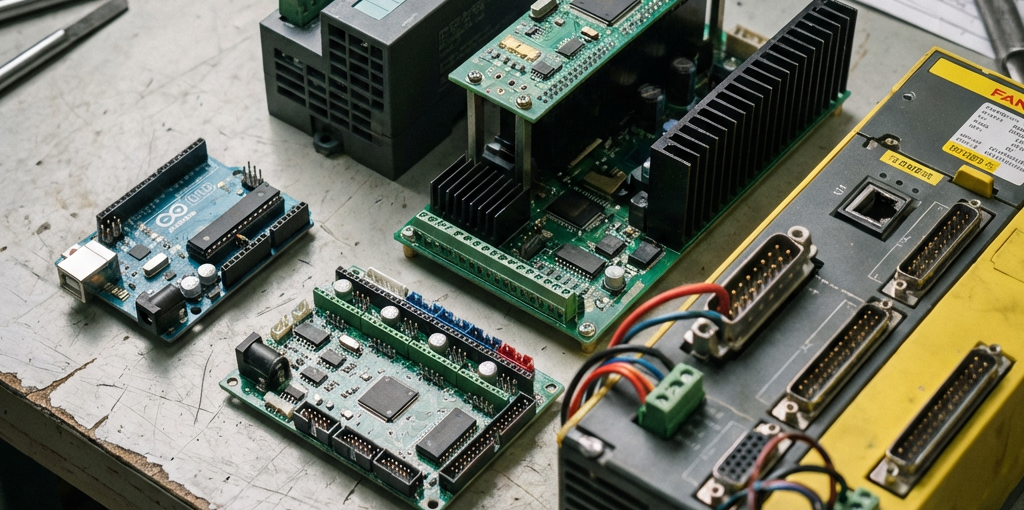
The CNC controller board is the “brain” of any CNC machine. It receives commands from your computer and translates them into electrical signals that move the stepper or servo motors. Selecting the right controller board is critical for the precision, speed, and reliability of your CNC operations.
In this guide, we’ll explore the most popular CNC controller systems on the market, from hobbyist-friendly boards to industrial-grade solutions.
What is a CNC Controller Board?
A CNC controller board acts as an interface between the computer (running CAD/CAM software) and the CNC machine’s mechanical components. It interprets G-code and controls the timing and direction of movement across multiple axes (X, Y, Z, and sometimes A, B, or C).
Popular CNC Controller Systems
1. GRBL-Based Controllers
GRBL is an open-source, high-performance software for controlling the motion of machines that move, that make things, or that make things move, and will run on an Arduino.
- Best For: Hobbyists, 3D printers, and small DIY CNC routers.
- Pros: Low cost, large community support, easy to set up.
- Cons: Limited to 3-axis (usually), less powerful for complex industrial tasks.
2. Mach3/Mach4 Controllers
Mach3 and its successor Mach4 are industry-standard software packages that turn a PC into a CNC machine controller. They often require a breakout board (BOB) to interface with the machine.
- Best For: Prosumers and small business machine shops.
- Pros: Highly customizable, supports up to 6 axes, robust feature set.
- Cons: Mach3 is older (requires parallel port or specialized USB/Ethernet adapter).
3. PlanetCNC
PlanetCNC provides a complete solution of hardware (controllers) and software. It’s known for its user-friendly interface and reliable USB/Ethernet connectivity.
- Best For: Users who want a plug-and-play experience with professional features.
- Pros: Excellent software integration, high-speed pulse rates.
- Cons: Proprietary hardware is required.
4. LinuxCNC
LinuxCNC is a free, open-source software system for the numerical control of machines. It runs on Linux with real-time extensions.
- Best For: Advanced users and industrial applications requiring high precision.
- Pros: Extremely flexible, supports complex kinematics, free.
- Cons: Steeper learning curve, requires a dedicated PC with a real-time OS.
Key Considerations When Choosing a Controller
When selecting a board for your CNC project, consider the following:
| Feature | Importance | Recommendation |
|---|---|---|
| Connectivity | High | Ethernet is generally more stable than USB for industrial environments. |
| Axis Support | Medium | Ensure it supports at least the number of axes you plan to use. |
| Input/Output (I/O) | High | Look for enough pins for limit switches, probes, and spindle control. |
| Software Compatibility | High | Make sure the board works with your preferred control software. |
Conclusion
The right CNC controller board depends on your budget, your machine’s requirements, and your technical comfort level. Whether you’re building a DIY engraver with GRBL or running a professional shop with Mach4 or LinuxCNC, the controller is the foundation of your precision work.
At CNC Parts Market, we provide a wide range of controller boards and interface components to keep your machines running at peak performance. Explore our collection today!