Stepper Motors vs. Servo Motors: Which One Does Your CNC Project Actually Need?
Choosing the right motor for your CNC (Computer Numerical Control) machine is one of the most critical decisions in the building or upgrading process. The debate between Stepper Motors and Servo Motors has existed for decades, and the “best” choice depends entirely on your project’s requirements, budget, and complexity.
In this guide, we’ll break down the differences, pros, and cons of each to help you decide which one is right for your next CNC project.
1. Understanding Stepper Motors
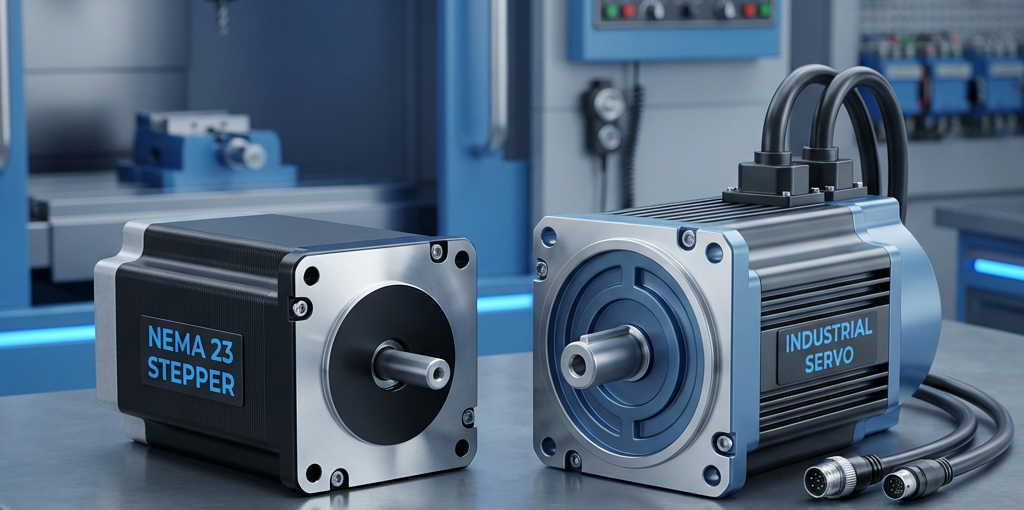
Stepper motors are the most common choice for hobbyist and entry-level CNC machines. They move in discrete “steps” (usually 1.8 degrees per step, or 200 steps per revolution).
Pros:
- Affordability: Stepper motors and their drivers are significantly cheaper than servo systems.
- Simplicity: They are easy to set up and don’t require complex tuning.
- High Torque at Low Speeds: They provide excellent holding torque, which is great for maintaining position.
- Open-Loop System: No feedback is required, simplifying the wiring.
Cons:
- Loss of Steps: If the motor is overloaded, it can “lose steps” without the controller knowing, leading to ruined workpieces.
- Noise and Vibration: They tend to be noisier and vibrate more at certain speeds.
- Torque Drop-off: Torque decreases rapidly as speed increases.
2. Understanding Servo Motors
Servo motors are the standard for industrial CNC machines and high-performance DIY builds. Unlike steppers, they operate in a “closed-loop” system.
Pros:
- Closed-Loop Accuracy: Servos use encoders to provide constant feedback to the controller. If the motor is pushed off course, it corrects itself.
- High Speed and Constant Torque: Servos maintain high torque across their entire speed range.
- Efficiency: They only draw the current needed for the load, making them cooler and more efficient.
- Smooth Operation: They are much quieter and run smoother than steppers.
Cons:
- Cost: Servo motors, encoders, and specialized drivers are much more expensive.
- Complexity: They require “tuning” (PID loops) to ensure they respond correctly to commands without oscillating.
- Wiring: More complex wiring due to the feedback loop.
3. Comparison Table: Stepper vs. Servo
| Feature | Stepper Motor | Servo Motor |
|---|---|---|
| System Type | Open-Loop (Usually) | Closed-Loop |
| Cost | Low | High |
| Setup Difficulty | Easy | Complex (Requires Tuning) |
| Reliability | Good (but can lose steps) | Excellent (Self-correcting) |
| High-Speed Torque | Low | High |
| Noise Level | Moderate to High | Low |
4. Which One Should You Choose?
Choose Stepper Motors if:
- You are building your first hobby CNC (3018, Shapeoko, etc.).
- You are on a tight budget.
- Speed is not your primary concern.
- Your machine is small to medium-sized.
Choose Servo Motors if:
- You are building an industrial-grade or high-speed machine.
- You cannot afford to lose steps (high-value materials).
- You need consistent precision at high speeds.
- You are comfortable with more complex electronics and software tuning.
Conclusion
For the majority of hobbyists, Stepper Motors provide the best balance of performance and price. However, if you’re looking to push your CNC to the limit with high-speed production and ultimate reliability, Servo Motors are the clear winner.