How to Choose the Best Focal Length for Your Laser Lens: 1.5″ to 4.0″ Explained
If you’re using a CO2 laser cutter (like a K40, Thunder, or custom build), the single most important part of your machine is the focusing lens. But when you look at replacement lenses, you’ll see different focal lengths like 1.5″, 2.0″, 2.5″, and 4.0″.
Choosing the wrong focal length can lead to charred edges, incomplete cuts, or blurry engraving. In this guide, we’ll explain the trade-offs and help you pick the right lens for your project.
What is Focal Length?
The focal length is the distance from the lens to the point where the laser beam is at its smallest, most intense diameter (the focus point).
Think of a lens like a magnifying glass. If you focus a beam of light to a tiny point, you get maximum heat. However, there’s a “sweet spot”—the depth of focus—where the beam remains relatively thin.
The Different Focal Lengths Compared
| Focal Length | Best Use | Depth of Focus (DoF) | Beam Spot Size |
|---|---|---|---|
| 1.5″ (38.1mm) | Very fine detail engraving, thin films. | Very Short | Smallest |
| 2.0″ (50.8mm) | All-purpose cutting & engraving (Standard). | Medium | Small |
| 2.5″ (63.5mm) | Cutting thicker materials (1/4″ to 3/8″). | Long | Medium |
| 4.0″ (101.6mm) | Deep cutting (up to 3/4″), foam, irregular surfaces. | Very Long | Large |
1. The All-Rounder: 2.0″ Lens
The 2.0″ lens is the most common lens shipped with new machines. It provides a good balance between a small spot size for engraving and enough depth of focus to cut through materials up to 1/4″ (6mm) thick with minimal taper.
2. The Detail Specialist: 1.5″ Lens
If your primary goal is high-resolution photo engraving or tiny text, the 1.5″ lens is your best friend. Because it focuses the beam to a smaller point, you get more detail. However, it is poor for cutting thick material because the beam diverges quickly once it passes the focal point.
3. The Cutting Powerhouse: 2.5″ & 4.0″ Lenses
When cutting through thick acrylic or plywood, the laser beam needs to stay thin through the entire thickness of the material. A 2.5″ lens or even a 4.0″ lens has a much longer “waist,” meaning the beam doesn’t spread out as quickly. This results in straighter vertical edges with less taper.
How to Tell if You Need a Different Lens
You should consider changing your lens if:
- Your edges are tapered: If your 1/2″ acrylic has slanted edges, you need a longer focal length (2.5″ or 4.0″).
- Your engraving is blurry: If you can’t get sharp detail on small text, a shorter focal length (1.5″) might help.
- You’re cutting irregular objects: If your material isn’t perfectly flat (like a curved bowl), a 4.0″ lens is more forgiving because it has a larger depth of field.
Lens Maintenance Tips
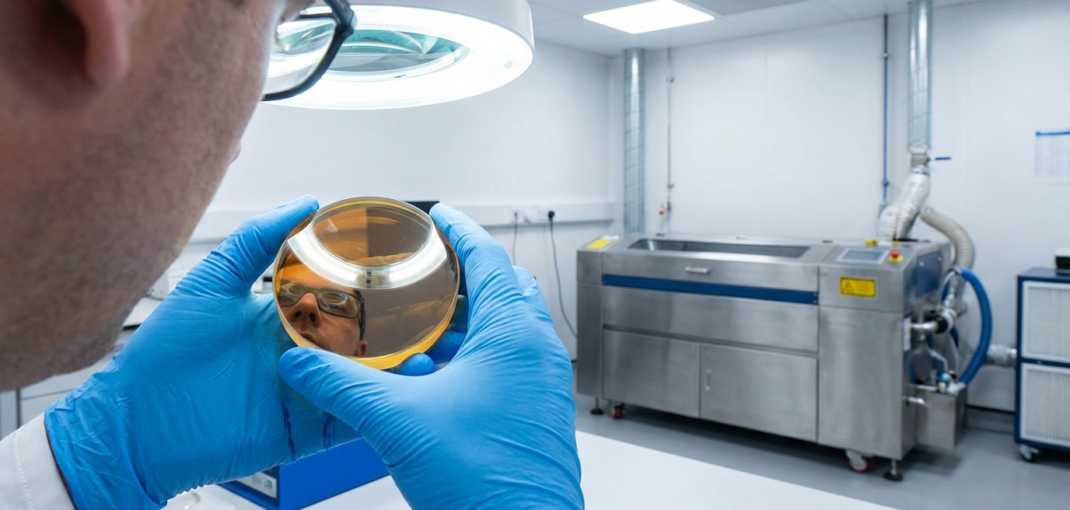
Regardless of the focal length, a dirty lens will fail.
- Clean daily: Use high-purity isopropyl alcohol and a lens tissue or cotton swab.
- Check for cracks: Heat from a dirty lens can cause it to crack over time.
- Use Air Assist: A strong stream of air protects the lens from smoke and debris during the cutting process.
Conclusion
Most users will find that a 2.0″ lens is perfect for 90% of their work. However, keeping a 1.5″ lens for fine engraving and a 2.5″ lens for thick cutting is a smart way to maximize your laser machine’s versatility.
Need a replacement laser lens? We carry a full range of ZnSe lenses and mirrors at cncpartsmarket.com!